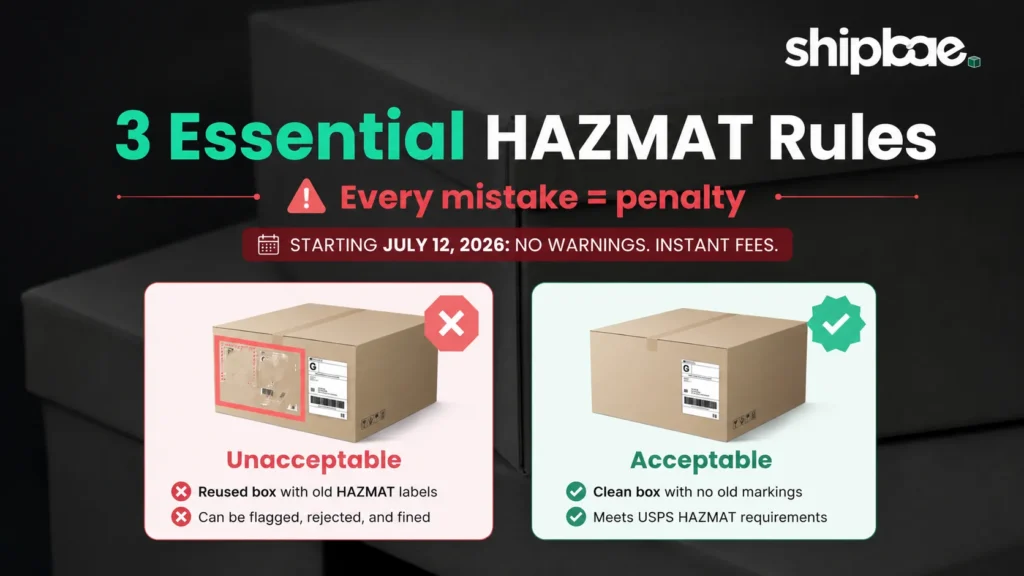
If you sell anything with a battery in it, anything pressurized, anything flammable, or anything that smells nice, you ship hazardous materials. You probably didn’t know that. Starting July 12, 2026, USPS is going to make sure you find out.
The rules for USPS HAZMAT shipping are tightening on multiple fronts at once. USPS is rolling out new per-package fees, enforcement is shifting to zero tolerance, and the existing civil penalty framework isn’t going anywhere.
If you ship through USPS, here’s what’s changing, what’s already in effect, and what to do about it before the deadline.
What Counts as HAZMAT (Probably More Than You Think)
USPS defines HAZMAT using the U.S. Department of Transportation’s standard: any article or substance capable of posing an unreasonable risk to health, safety, or property during transportation.
The category is broad. It catches a long list of products that show up in normal ecommerce orders every day:
- Lithium batteries, loose batteries, power banks, replacement laptop batteries
- Devices containing lithium batteries, phones, laptops, tablets, electronic toys, greeting cards
- Aerosols, hairspray, deodorant, dry shampoo, cooking spray, spray paint
- Flammable liquids, perfume, cologne, nail polish, hand sanitizer, alcohol-based cosmetics
- Lighters and matches (strike-anywhere matches are prohibited entirely)
- Magnetized materials, speakers, certain motors
- Mercury (permanently banned regardless of packaging)
If your catalog touches any of those categories, you are a HAZMAT shipper.
Can You Ship Batteries via USPS?
Yes, but with restrictions.
Lithium-ion batteries installed in devices and under 100 watt-hours can ship via Ground Advantage with proper HAZMAT identifiers and rigid packaging.
Loose lithium batteries face stricter limits and almost always require ground transportation only.
Used or damaged electronics must be marked:
- Restricted Electronic Device
- Surface Transportation Only
Internationally, most lithium battery shipments are not allowed.
The takeaway: if you’re shipping anything with a battery, you need to know the UN number, the allowed service level, and whether it can fly.
The Three Rules Every HAZMAT Shipper Has to Get Right
1. Check the Carrier
Not every carrier accepts every type of HAZMAT.
USPS prohibits many items outright. UPS and FedEx accept more, but only if you have a Dangerous Goods Contract, which requires training and approval.
If USPS won’t take your product, you need a fallback carrier ready before you ship.
2. Ground Only
Many HAZMAT items can only move via ground.
This includes:
- Flammable liquids
- Loose lithium batteries
- Used or damaged electronics
USPS Ground Advantage is the primary service here.
Choosing the wrong service level is one of the fastest ways to trigger fees.
3. Label Clearly
HAZMAT shipments must:
- Include “HAZMAT” above the barcode
- Use correct USPS HAZMAT type codes
- Follow Pub 52 requirements
Packaging must meet rigid standards:
- ECT 32 or 200 lb burst (≤20 lbs)
- ECT 44 or 275 lb burst (>20 lbs)
Flimsy boxes and poly mailers do not qualify.
Reusing Boxes Can Trigger HAZMAT Violations
Reusing boxes sounds harmless. In some cases, it can get your shipment flagged instantly.
A common mistake is reusing a box that previously carried hazardous materials, especially Amazon boxes with lithium battery labels like UN3481.
Even if your current shipment is not HAZMAT, those old markings still matter.
USPS scanners do not interpret intent. They read what is physically on the box.
If a legacy HAZMAT label, barcode, or marking is still visible, the system can:
- Flag the package as undeclared HAZMAT
- Reject it from processing
- Apply HAZMAT noncompliance fees
- Trigger additional inspection or delays
This is exactly the type of issue zero-tolerance validation is designed to catch.
Important:
Even a faint outline of an old HAZMAT label can be detected during scanning and sorting. Covering labels with tape or marker is not enough, scanners can still pick up underlying barcodes and symbols.
What to do instead:
- Remove or fully obscure all old labels and markings
- Avoid reusing boxes that previously had HAZMAT identifiers
- Use clean, compliant packaging when there’s any risk of misinterpretation
If the system thinks it is HAZMAT, it is treated as HAZMAT.
What’s New on July 12, 2026
USPS is introducing two new domestic HAZMAT fees:
HAZMAT Handling Fee
A flat per-package surcharge for all HAZMAT shipments.
HAZMAT Noncompliance Fee
A per-piece fee applied to every noncompliant package.
No thresholds. No warnings. Every mistake is charged.
Validation includes:
- HAZMAT identifier
- Service Type Code
- Extra Service Code
- Service Icon
- DOT markings
Miss one, you pay.
Why USPS Is Doing This Now
Two reasons:
1. Safety
Lithium battery fires and undeclared HAZMAT incidents have increased across the network.
2. Cost Alignment
UPS and FedEx already charge $40–$50+ per HAZMAT shipment.
USPS is closing that gap.
At the same time, USPS has raised rates multiple times in 2026, adding pressure across the board.
What to Do Before July 12
1. Audit Your Catalog
Identify every SKU that could qualify as HAZMAT.
2. Validate Your Shipping Software
Make sure HAZMAT codes are applied automatically, not manually.
3. Upgrade Packaging
Use compliant, rigid corrugated boxes.
4. Build a Carrier Fallback
Set up UPS or FedEx Dangerous Goods capability if needed.
Where ShipBae Fits In
ShipBae is built for this exact problem.
It:
- Routes shipments to the correct carrier automatically
- Applies correct HAZMAT identifiers at label generation
- Enforces service-level restrictions (ground only, etc.)
- Compares rates across carriers in real time
This is the layer that prevents noncompliance fees before they happen.
This shift toward automation and enforcement is part of a broader trend across shipping, where systems are moving from reactive to predictive decision-making .
FAQ
Can you ship batteries via USPS in 2026?
Yes, with restrictions. Installed batteries under 100 Wh can ship via Ground Advantage. Loose batteries are ground-only and more restricted.
What is the new USPS HAZMAT fee?
A handling fee for all HAZMAT shipments and a per-piece noncompliance fee for violations.
What happens if I ship HAZMAT undeclared?
Civil penalties from $250 to $100,000 per violation, plus new noncompliance fees.
Is USPS the only carrier with HAZMAT rules?
No. UPS and FedEx require Dangerous Goods Contracts and training.
How do I know if my product is HAZMAT?
Check the SDS for the UN number or use USPS’s HAZMAT lookup tool.
Does ShipBae help with compliance?
Yes. ShipBae automates labeling, routing, and service restrictions to prevent violations.