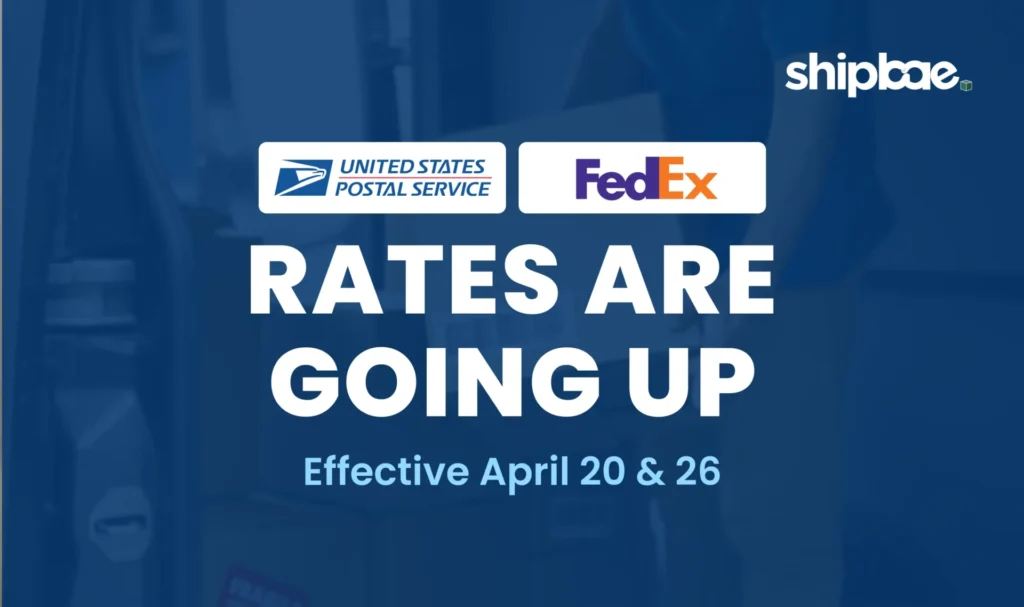
Shipping costs aren’t just rising. They’re stacking.
The USPS rate increase we covered last week is now official. The approved ~8% increase will be built directly into base rates across Priority Mail, Ground Advantage, and other core services.
No surcharge. No temporary fee. Just higher costs per package starting April 26.
Now add in what’s coming next: FedEx will increase One Rate pricing starting April 20, just days before USPS changes take effect.
This isn’t happening in isolation. It’s part of a broader pattern where multiple carriers are adjusting pricing within the same window, making cost increases hit faster and harder.
What Actually Changed
USPS has finalized its transportation-related, time-limited price adjustment:
- ~8% increase across key services
- Built directly into base rates
- Applies nationally
- Takes effect April 26, 2026
Unlike carriers that rely heavily on surcharges, USPS is embedding these costs directly into pricing. That means you won’t see a separate line item, but you will see higher costs every time you print a label.
UPS already implemented its general rate increase earlier this year, with base rate changes and expanded surcharges continuing to impact total shipping costs into 2026.
Taken together, this creates a layered effect. Base rates go up. Surcharges expand. Pricing shifts across multiple carriers at once.
Why This Matters Right Now
This is more than a standard rate increase. It’s a stacked cost event.
- USPS raises base rates
- FedEx introduces pricing changes in the same window
- UPS already increased rates earlier this cycle
For ecommerce brands, this compresses the timeline. Costs increase across carriers at nearly the same time, leaving less room to react.
If your operation relies on:
- One default carrier
- Static shipping rules
- Manual decision-making
There’s no buffer. The increase shows up immediately in your cost per order.
And because these changes are happening across carriers, switching alone isn’t always enough. The advantage comes from comparing and adapting, not just moving volume.
The Bigger Shift (Already Happening)
This moment reflects a larger shift in how shipping is managed.
Shipping is no longer stable enough to run on fixed assumptions. Rates change more frequently. Carrier performance varies by lane. Demand is less predictable, especially with the rise of AI-driven shopping and social commerce.
The old model:
- Set a carrier
- Lock in a workflow
- Revisit occasionally
The new reality:
- Compare in real time
- Adjust continuously
- Optimize per shipment
This is the move from reactive shipping to adaptive shipping.
And moments like this are what force that transition.
Where Ecommerce Brands Feel the Impact
1. Margin Compression
If USPS is your default carrier, this increase hits across your entire volume.
Even commonly used services like Priority Mail or a priority mail flat rate envelope will see cost increases. At scale, even small changes compound quickly.
- +$0.80 per package
- 1,000 shipments/month = +$800
- $9,600 annually
For higher volume brands, that number scales fast.
2. Base Rate Impact
Because this increase is built into base rates:
- Costs are reflected directly in pricing tables
- There’s no surcharge to isolate or remove
- Every shipment carries the increase
It simplifies pricing structure, but removes flexibility. You can’t avoid it within a single-carrier setup.
3. Default Decisions Get More Expensive
Most brands don’t evaluate every shipment. They rely on defaults.
But when:
- Rates increase
- Surcharges expand
- Carrier performance shifts
Those defaults start costing more. Quietly, but consistently.
This is where most overpayment happens.
What Smart Shippers Are Doing Instead
The brands protecting margin right now aren’t waiting for stability. They’re adjusting in real time.
That includes:
Multi-Carrier Rate Shopping
Comparing USPS, UPS, FedEx, and regional carriers for each shipment instead of relying on a single default.
Dynamic Carrier Selection
Routing packages based on cost, speed, and performance, not habit.
Continuous Cost Monitoring
Tracking cost per shipment and identifying where increases are hitting hardest.
It’s not about overhauling everything overnight. It’s about introducing flexibility into decisions that used to be fixed.
This is where the gap is forming between operators who adapt and those who absorb costs.
A Simple Example
Let’s say you ship 1,000 packages per month using USPS.
An 8% increase adds roughly:
- +$0.80 per package
- +$800 per month
- +$9,600 per year
Now layer in additional carrier increases and surcharges, and that number climbs even higher.
Now compare that to a multi-carrier setup that saves $0.50 on even half your shipments.
That’s $3,000 back annually.
Same volume. Different outcome.
The difference comes from flexibility.
What You Should Do Right Now
You don’t need to rebuild your operation overnight. But you do need to respond.
Start with:
- Reviewing your carrier mix and identifying dependencies
- Flagging where USPS is your default option
- Testing alternative carriers on your most common lanes
- Comparing real costs after April 20 and April 26 changes take effect
- Tracking your true cost per shipment, from label to packing slip
Small adjustments here can offset a meaningful portion of the increase.
Because once base rates go up, the only lever left is how you ship.
The Bottom Line
This isn’t one rate increase. It’s a signal.
Shipping costs are rising across carriers, at the same time, with less predictability and more complexity than before.
The brands that stay flexible, compare options, and adapt quickly will absorb it.
The ones that rely on static workflows will feel it.